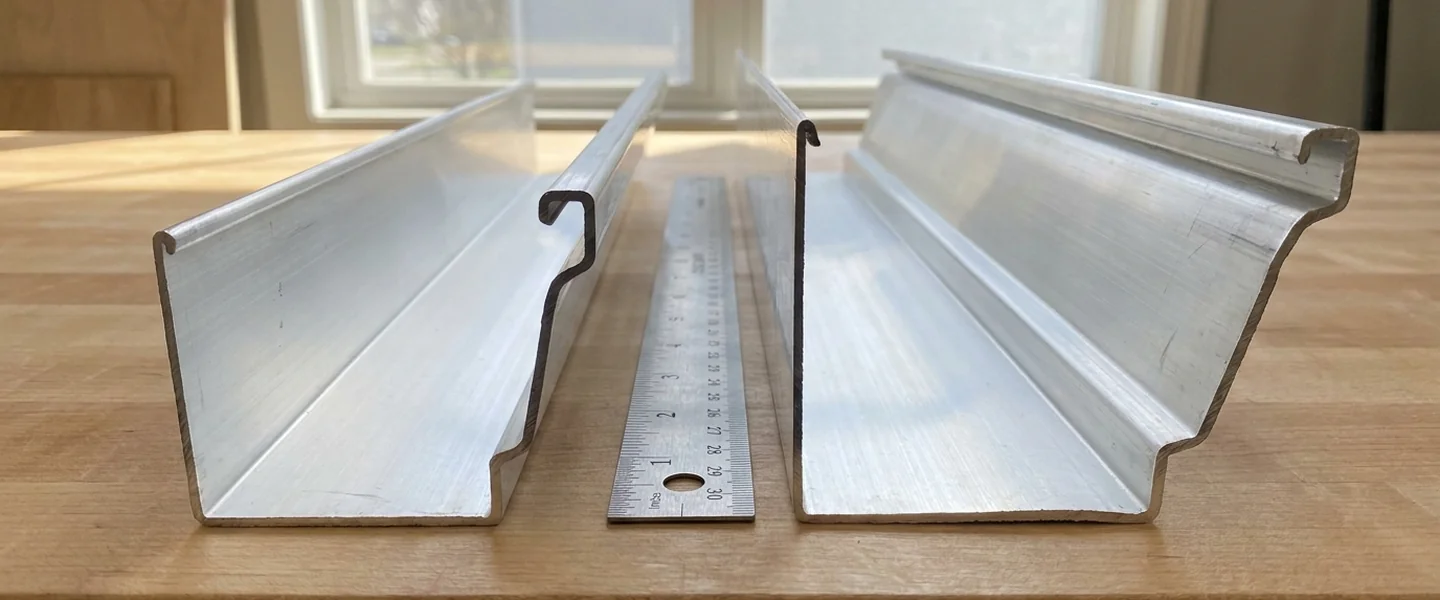
5″ vs 6″ Gutters in Raleigh: Which Size Matches Your Roof?
Locally based gutter specialists serving the Raleigh metro.
- Licensed & Insured in North Carolina
- Locally Owned, Raleigh-Based
- 25-Year Clog-Free Guard Warranty
- Free On-Site Estimates
- 5-Year Workmanship Warranty
Walk into a big-box home-improvement store in the Raleigh metro and the default option for residential gutters is 5″ K-style aluminum with 2×3 downspouts. Walk down the street to a recently-built tract home in Knightdale or Holly Springs and that’s what the builder installed. So why do we tell so many Raleigh homeowners they need to upgrade to 6″ K-style with 3×4 downspouts? Because the rain volumes and debris loads in the Triangle systematically overwhelm the 5″/2×3 standard, and the upgrade pays off in years 1-3 of ownership.
What “5-inch” and “6-inch” Actually Mean
The number refers to the width of the top opening of the gutter — 5″ is 5 inches wide at the top, 6″ is 6 inches wide. The depth and back-leg are sized proportionally. Critically, the difference in carrying capacity is not 20% (the simple width difference) — it’s about 40% because the cross-sectional area scales with both width and depth. A 6″ K-style gutter holds roughly 1.4x the water volume of a 5″ K-style at any given depth of flow.
What 2×3 vs 3×4 Downspouts Actually Mean
2×3 is a 2-inch by 3-inch downspout cross-section. 3×4 is 3-inch by 4-inch. The flow capacity difference is dramatic — a 3×4 downspout moves roughly 2x the water of a 2×3 at the same pressure head. For the piedmont thunderstorm rain volumes we see in Raleigh (4″+/hour bursts), the 3×4 is the right answer on most home plans. Builders use 2×3 because it’s cheaper to stock and easier to install through the standard openings in pre-fab gutter sections.
The Math for Raleigh Rain Rates
A 4″/hour rain rate on a 600 sq ft roof plane produces about 250 gallons per hour of water flow to the gutter. A 5″ gutter with two 2×3 downspouts at 50-foot spacing can handle that — barely. A 4″/hour rate on a 1,200 sq ft roof plane (common on a two-story tract home with a long horizontal eave) produces about 500 gallons per hour, and the same 5″ gutter system overflows at the outside corners during every event of that intensity. The same 1,200 sq ft roof plane with 6″ gutters and 3×4 downspouts handles 800+ gallons per hour without overflowing. The capacity multiplier matters most on the roof planes that drain the most area.
Which Roofs Need the 6″ Upgrade in Raleigh
Two-story homes with long horizontal eaves. Almost all of them benefit from the 6″ upgrade. The roof area draining to a single 50-foot gutter run is too large for 5″/2×3 in our rain rates.
Steep-pitch roofs. A 12/12 pitch roof generates faster water flow than a 4/12 pitch roof for the same square footage because the water has less travel time across the roof plane before hitting the gutter. Steep roofs benefit from the 6″ upgrade even on smaller footprints.
Homes under mature loblolly pine canopy. Pine needles accumulate at the downspout drop outlets and reduce effective flow capacity even when the gutter itself is clear. The larger 3×4 downspout has more reserve capacity to handle this reduced effective area.
Homes with chronic corner overflow. If your existing 5″ gutters overflow at the corners during heavy thunderstorms, the 6″ upgrade is the right diagnosis regardless of the other factors.
Which Roofs Are Fine With 5″
Single-story ranches with short gutter runs. If no single gutter run drains more than about 500-600 sq ft of roof area and you don’t have heavy debris from overhanging trees, the 5″/2×3 standard handles the volumes adequately.
Homes in non-pine areas with mature hardwood gutters that get cleaned twice a year. The maintenance schedule matters as much as the capacity — clean gutters handle more water than partially-clogged gutters.
Newer homes with adequate downspout spacing. If the builder went with 5″ but installed downspouts at 30-foot spacing rather than 50-foot, the system has more reserve capacity than the default and may be fine.
The Cost Difference
The 6″ upgrade typically adds 15-25% to the installed gutter cost over the 5″ equivalent. The aluminum is wider so the material cost is higher; the downspouts are larger so the material cost is higher; the hangers are slightly different so labor isn’t materially different. The cost premium pays off in years 1-3 in any home that previously had chronic corner overflow — eliminating the need for emergency cleanings during storm season, the fascia repair from years of backflow, and the foundation work from saturated soil at the corners of the home.
What Doesn’t Justify the Upgrade
If your existing 5″ system has never overflowed and your home doesn’t have the risk factors above, the 6″ upgrade is overkill. We will tell you that during the inspection — we don’t push the upgrade when the smaller system is adequate for your specific home.
Color and Aesthetic Considerations
The 6″ gutter is visually larger than the 5″ — about an inch taller from the bottom of the K profile to the top edge. On most homes, the difference is barely noticeable from the street. On some historic or architectural homes where the gutter is meant to be visually inconspicuous, the larger profile can be a consideration. The half-round profile is sometimes a better aesthetic match for older historic homes, but it has its own capacity-and-cost tradeoffs we’d cover in the inspection.
Half-Round vs K-Style
K-style is the modern default — flat back, decorative front with the “K” shape, available in a wide range of colors. Half-round is the older style, more often seen on historic homes, with a curved cross-section. K-style has more carrying capacity per linear inch of cross-section than half-round and is significantly less expensive. We install both, but the K-style is right for most Raleigh homes.
What About Even Larger (7″ or 8″)?
You can install 7″ and 8″ gutters in residential applications. They are uncommon and typically not necessary for Raleigh-area homes. We install them on rare specialty applications — homes with very large single-plane roof areas, custom-built homes with architectural-statement gutters, or commercial-residential conversions where the rain volume genuinely warrants it.
Common Misconceptions About Gutter Sizing
“5” is fine because it’s what the builder put on.”
Builder-grade gutter sizing optimizes for cost on the build, not performance over the life of the home. The Raleigh rain volumes and tree canopy frequently exceed what 5″ can handle on the as-built roof.
“6” is just upselling.”
Sometimes it is — if a contractor pushes 6″ on a single-story ranch with short runs, they’re optimizing for revenue. When 6″ is recommended for a two-story home with long eaves and chronic overflow, it’s the right diagnosis.
“Bigger gutters means more debris accumulation.”
Counter-intuitively, often the opposite. The larger cross-section means debris matts have more room to move, and the larger downspout is less likely to be choked by pine needles or oak leaves. The maintenance schedule is similar.
Questions to Ask the Contractor
- What’s the roof-plane square footage draining to each gutter run?
- At what rain rate does the existing system start overflowing?
- How many downspouts per side, and at what spacing?
- What aluminum gauge are you installing — .027 or .032?
- What hanger style and spacing?
- If we go with 5″, how will you handle the chronic corner overflow issue?
Bottom Line
For most two-story homes and complex roof plans in the Raleigh metro, the 6″ K-style upgrade with 3×4 downspouts is the right call. For single-story ranches with short runs and limited tree canopy, 5″ K-style is adequate. The inspection visit identifies which one your home needs and quantifies the rain-volume math specific to your roof. Call (919) 739-4341 for a free 20-30 minute inspection and a written, itemized quote that specifies the right size for your home.
Service Areas We Cover
We serve Raleigh and the entire Triangle metro. Click your suburb for local details and what we typically find on homes in your zip code:
Free Gutter Inspection in Raleigh
Same-week appointments. No high-pressure sales. Serving Raleigh and surrounding areas including Cary, Apex, Wake Forest, Garner, Holly Springs, Knightdale, Morrisville, Fuquay-Varina.