Best Gutter Guards for North Carolina’s Climate (Honest Comparison)
Locally based gutter specialists serving the Raleigh metro.
- Licensed & Insured in North Carolina
- Locally Owned, Raleigh-Based
- 25-Year Clog-Free Guard Warranty
- Free On-Site Estimates
- 5-Year Workmanship Warranty
“Best gutter guards” is the most-searched gutter-related query in the Raleigh metro and almost every other piedmont city. The answer most contractors give is whatever brand they happen to install — which is helpful only if their installed brand actually performs in your climate. This post is an honest comparison of the main gutter-guard styles available in the Triangle, with a clear recommendation based on what actually works against loblolly pine needles, hardwood leaves, and piedmont thunderstorm rain volumes.
The Five Main Guard Styles
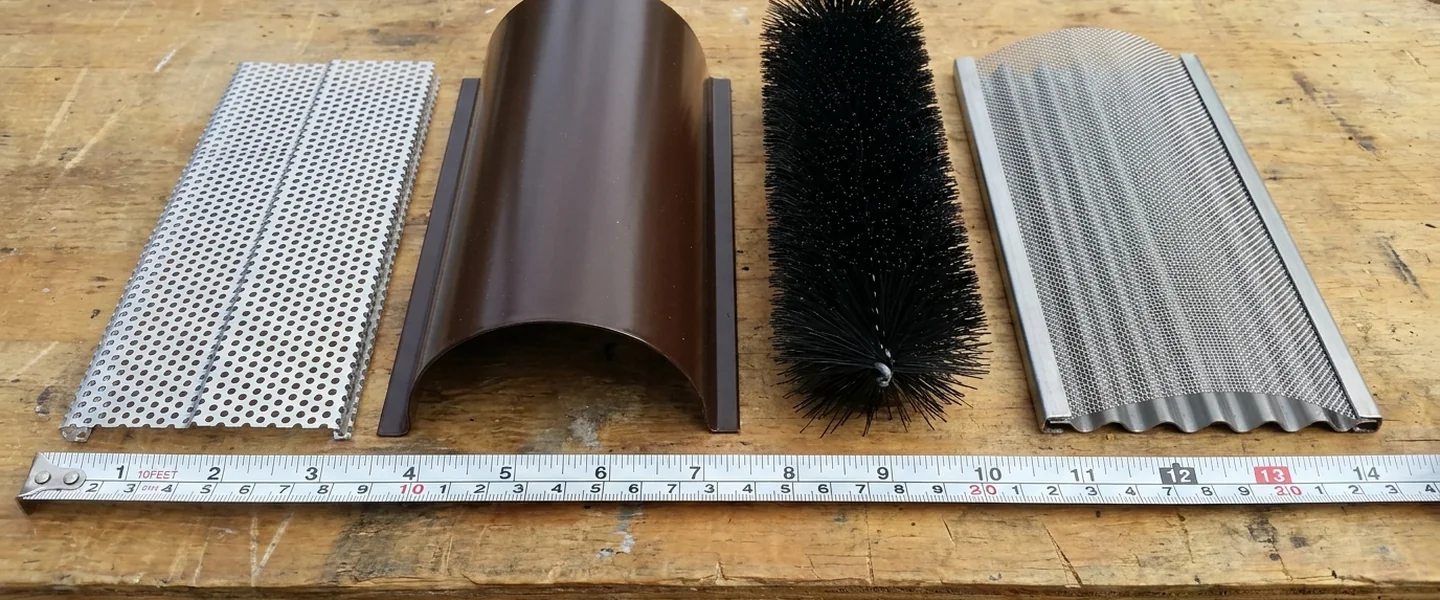
There are five main styles of gutter guards on the market. Each has different debris-handling and water-handling tradeoffs, and the right choice in North Carolina is not the same as the right choice in Arizona or Maine.
1. Perforated Metal Screens (Big-Box Standard)
Sheet-metal panels with holes punched in them, snapped or clipped onto the top of the gutter. Cheapest option. Available at every big-box store. Easy DIY install.
Performance in Raleigh: Poor. The hole size required to let water through is large enough that pine needles drop straight in and oak leaves wedge into the holes. We pull these guards off Raleigh-area homes constantly because the gutter underneath is more clogged with the guard than it was without.
Verdict: Avoid for any home under mature pine or hardwood canopy. Marginal only for clean-canopy homes.
2. Foam Inserts
Polyurethane foam blocks that fit inside the gutter and let water pass through while blocking debris on the top surface.
Performance in Raleigh: Bad. The foam absorbs and holds water, becoming a wet mass that promotes mold and mildew. The top surface mats with pine needles within a single fall and stops shedding debris. The product is also a habitat for insects in the Raleigh climate.
Verdict: Hard pass. We don’t install foam inserts and we pull them out when we find them.
3. Reverse-Curve Surface-Tension Guards (Helmet Style)
A solid metal cover that curves over the top of the gutter; water sticks to the surface via surface tension and runs into a slot at the front edge, while debris falls off the front.
Performance in Raleigh: Mixed. Works reasonably well on broad hardwood leaves that fall cleanly off the curved surface. Fails on pine needles, which lodge in the front slot and accumulate. During heavy piedmont thunderstorms, the surface-tension flow exceeds capacity and water cascades over the front of the guard, defeating the purpose.
Verdict: Marginal in pine-heavy areas. Better than perforated metal but worse than micro-mesh.
4. Brush Inserts
Cylindrical brushes (like oversized pipe cleaners) inserted into the gutter, with bristles that catch debris on top while water passes through.
Performance in Raleigh: Mediocre. Easy DIY install. Captures larger debris reasonably well but pine needles weave between the bristles and clog the brush itself within a fall season. Has to be removed and cleaned almost as often as a gutter without any guard.
Verdict: A modest improvement over no guard for hardwood-only areas. Not worth the install cost in pine-heavy Raleigh neighborhoods.
5. Micro-Mesh Stainless Steel
A stainless steel mesh panel with very small openings (typically 50-200 microns) mounted over the gutter. Debris of any size — including pine needles and shingle grit — is excluded from the gutter while water passes through.
Performance in Raleigh: Excellent. The micro-mesh is small enough to exclude pine needles, oak catkins, and even shingle grit. The stainless steel doesn’t rust in the humid Raleigh climate, doesn’t degrade in UV, and carries a 25-year manufacturer clog-free warranty. The water flow rate through micro-mesh is high enough to handle piedmont thunderstorm rain volumes (we’ve stress-tested with a hose at full rate at the high end of the gutter — flow remains through the mesh, not over it).
Verdict: The only style we install. Higher install cost than the cheaper guards but the only style that performs against the Triangle’s debris and rain load.
Why We Don’t Install Anything But Micro-Mesh in Raleigh
We tried other styles in our first few years of business. The customer-satisfaction data was unequivocal — homes with perforated metal, foam, reverse-curve, or brush guards consistently came back to us within 2-3 years with clog complaints. Homes with micro-mesh stainless came back rarely, and when they did, it was usually for the annual top-side blow-off that the manufacturer recommends (which is a maintenance task, not a failure). We standardized on micro-mesh and stopped offering the other styles. The 25-year clog-free warranty is enforceable because the product actually delivers what it promises in the North Carolina climate.
What About the “Big Brand” Micro-Mesh Companies?
You’ve seen the TV ads for LeafFilter, Gutter Helmet, LeafGuard, and others. The products themselves are mostly genuine — the issue is the install cost. National-franchise micro-mesh installs in the Raleigh metro routinely run 2-3x the cost of a local specialist installing the same or comparable mesh product. The mesh and the warranty are essentially equivalent across reputable manufacturers; what you pay extra for at the national franchises is the advertising and the sales infrastructure, not the install quality.
Install Detail That Matters More Than Brand
Within the micro-mesh category, the install detail matters more than the brand name. Specifically: the mesh must be mounted to the front of the gutter (not slid into the gutter), the fasteners must be stainless (galvanized fasteners corrode against the stainless mesh), the panels must overlap properly at joints, and the downspout drop outlets must have a maintenance-access detail so the drops can be inspected annually. A good local installer with attention to these details produces a better outcome than a national franchise with poor field crew oversight.
What Micro-Mesh Doesn’t Do
It’s not magic. Specifically: it does not eliminate the need for top-side maintenance — we recommend an annual blow-off to clear accumulated debris from the top surface, especially in the worst pine-needle neighborhoods in Cary and Apex. It does not protect against ice dams in unusually cold winters. It does not prevent overflow if the underlying gutter is undersized for the roof area — micro-mesh handles debris, but the gutter capacity itself still has to match the rain volumes.
Cost-Benefit by Home Type
Single-story ranches with limited tree canopy: Micro-mesh is a luxury, not a necessity. The annual cleaning cost is low and the homeowner can safely do it themselves or hire it out.
Two-story homes in master-planned subdivisions: Micro-mesh has the strongest cost-benefit. The ladder-cleaning risk and the cleaning service cost over 10+ years exceed the install cost of the guard.
Homes under mature loblolly pine canopy: Micro-mesh is borderline mandatory. The cleaning frequency without guards is 3-4x per year, and the wear on the gutter from continuous debris loading shortens system life.
Older homes with original sectional gutters: Replace the gutters first, then install the guards. Installing guards on a failing sectional system is throwing good money after bad.
Common Misconceptions About Gutter Guards
“All gutter guards basically work the same.”
They don’t. The performance gap between perforated metal and micro-mesh in the Raleigh climate is enormous.
“Gutter guards eliminate all maintenance.”
They don’t. Even the best micro-mesh needs an annual top-side blow-off. They reduce maintenance from 2-3 cleanings per year to one quick maintenance visit.
“I can install guards myself and save money.”
You can install the cheap perforated guards. The micro-mesh systems require specific fastener types and panel-joint detailing that DIY installs typically get wrong. We’ve removed dozens of DIY micro-mesh installs that were causing more problems than they solved.
“The big-name TV brands are better.”
They aren’t — the product is mostly equivalent to what a local specialist installs. The brand premium reflects advertising, not install quality.
Questions to Ask the Contractor
- What guard style do you install — perforated, reverse-curve, micro-mesh, brush, foam?
- If micro-mesh, what micron size and is the mesh stainless steel?
- What fastener material — stainless, galvanized, aluminum?
- What’s the manufacturer warranty length and is it transferable to a new homeowner?
- What’s the recommended maintenance schedule for the installed product?
- Will you provide before/after photos of a similar install in the past year?
Bottom Line
For the Raleigh climate — loblolly pine canopy, hardwood leaf flush, piedmont thunderstorm rain rates — the right gutter guard is micro-mesh stainless steel installed by a local specialist with attention to fastener material and joint detail. The cheaper alternatives don’t perform; the national-franchise micro-mesh installs are over-priced for the same product. Call (919) 739-4341 for a free 20-30 minute inspection and a written quote on a properly-installed micro-mesh system.
Service Areas We Cover
We serve Raleigh and the entire Triangle metro. Click your suburb for local details and what we typically find on homes in your zip code:
Free Gutter Inspection in Raleigh
Same-week appointments. No high-pressure sales. Serving Raleigh and surrounding areas including Cary, Apex, Wake Forest, Garner, Holly Springs, Knightdale, Morrisville, Fuquay-Varina.