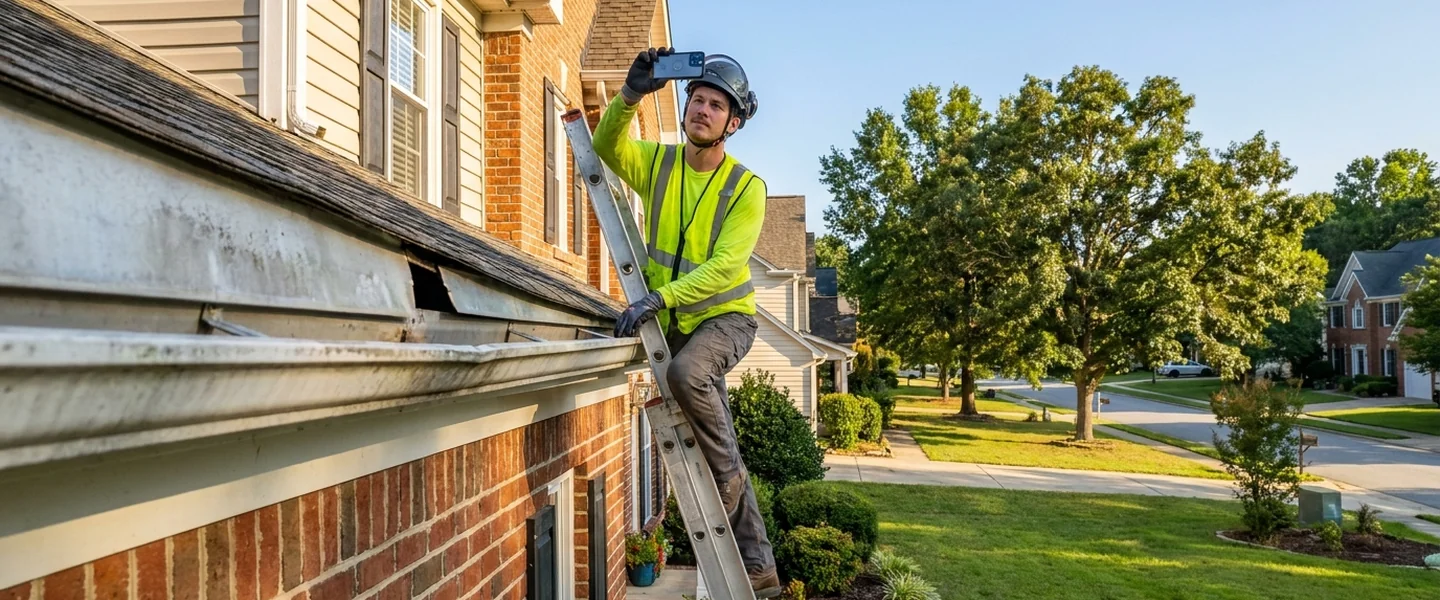
How to Tell If Your Gutters Need Replacement vs Repair
Locally based gutter specialists serving the Raleigh metro.
- Licensed & Insured in North Carolina
- Locally Owned, Raleigh-Based
- 25-Year Clog-Free Guard Warranty
- Free On-Site Estimates
- 5-Year Workmanship Warranty
One of the most common calls we get from Raleigh-area homeowners is some version of “Three companies told me I need full gutter replacement, but I’m not sure I really do.” The honest answer in our trade is that yes, sometimes full replacement is genuinely the right scope — but often a targeted repair, re-hang, or downspout upgrade solves the problem for a fraction of the replacement cost. This post explains how to tell the difference, with specific failure modes that point one way or the other.
What Repair Can Address
Targeted gutter repair is the right scope when the underlying gutter material is sound but specific failure modes have developed:
Loose or pulled hangers. If you have a 1980s-1990s home with original spike-and-ferrule hangers that have loosened over time, re-hanging with modern concealed hidden hangers is the right fix. The gutter itself is fine; just the attachment has failed.
Sealant failure at corners and end caps. Tripolymer sealants degrade over 15-20 years and develop slow leaks at the corners and end caps. Cleaning out the old sealant and applying fresh sealant restores the system without replacing the gutter.
Loose or detached downspouts. A downspout that has pulled away from the wall, or an elbow that has separated from the body, is a simple repair: new straps, new fasteners, sealant on the joint.
Pitch correction. Gutters that have gone out of pitch over time (typically toward backwards from settled hangers) can be re-pitched without full replacement. We loosen the hangers, set the proper pitch, and re-tighten.
Fascia repair behind otherwise-sound gutters. If the fascia has rotted from years of chronic backflow but the gutter itself is sound, we can lift the gutter, replace the fascia, and re-hang the same gutter. This is a half-replacement scope — same gutter, new substrate.
What Replacement Genuinely Requires
Full gutter replacement is the right scope when the gutter material itself has failed in ways that can’t be patched:
Rust-through on galvanized systems. Older brick-ranch homes in Wake Forest and the original Raleigh neighborhoods often have 1960s-1970s galvanized steel gutters that have rusted through at the bottom. You can see it from the ground — the gutter has a strip of rust along the lower edge with visible perforations. Replacement is the only option; you can’t patch through-rust at every seam and joint.
Multiple sectional seam separations. A sectional gutter system with one or two leaky seams can be resealed. A system with seam separations every 10-15 feet has structurally failed — the freeze-thaw cycling has pulled the slip joints apart and they will not hold sealant indefinitely. Replace with seamless.
Bent or crushed sections. Gutter sections that have been crushed by fallen tree limbs or other impact damage are usually beyond repair — the K-profile is no longer dimensionally sound and water flow is permanently compromised through that section. Replace the affected runs.
Undersized for the roof area. If the underlying 5″ gutter is simply too small for the rain volumes draining to it (chronic corner overflow even when clean), the right answer is replacement with 6″ K-style. This is a sizing failure, not a maintenance failure.
Original Raleigh-builder spec on a 25+ year old home. Builder-grade aluminum gutters from the 1990s and early 2000s have reached the end of their effective service life by the mid-2020s. The aluminum has fatigue cracks at the hangers, the sealant has degraded across the entire system, and the warranty has been expired for 15+ years. Replacement is usually the right call rather than chasing failures across the system.
The Gray Zone
Many Raleigh-area gutter systems are in a gray zone where either repair or replacement could be defended. In these cases, we recommend evaluating two factors:
Age and remaining service life. A 10-year-old aluminum system with one or two issues is worth repairing — it has 10-15 years of remaining service life. A 25-year-old aluminum system with the same issues is closer to end-of-life and replacement is the better long-term value.
Cost ratio. If the repair scope is more than 50-60% of the replacement cost, replacement usually wins on long-term value. If the repair scope is 25-40% of replacement, repair is almost always the right call.
What the National Franchise Push Looks Like
National-franchise gutter operations have a structural incentive to push replacement on every job. Their pricing model and sales structure are optimized for replacement scope, not repair scope. The kitchen-table-close model produces replacement quotes in the high four to low five figures even for systems that are fundamentally sound and need a few hundred dollars of repair. Our experience is that 30-40% of the “full replacement” quotes we second-opinion in the Raleigh metro should have been repair quotes.
What the Repair-First Approach Looks Like
A local specialist with a repair-first approach inspects the system, identifies the specific failure modes present, and writes the smallest scope that addresses each one. If the gutter itself is sound, the scope is repair-oriented. If the gutter has structurally failed, the scope is replacement. The recommendation is driven by the actual condition, not by the sales script.
How to Tell What Your Home Needs Without a Full Inspection
From the ground, you can do a quick assessment:
Look at the bottom of the gutter run. If you see rust strips or perforations on a galvanized system, you’re looking at replacement. If the aluminum is smooth and unstained on the bottom edge, it’s likely sound.
Look for backflow staining on the siding above the gutter. Chronic backflow staining usually indicates clogs and pitch issues, not gutter failure. Repair-oriented scope.
Look for visible sagging in the middle of long runs. Hanger pull is usually repairable — re-hang with modern concealed hangers. Not necessarily replacement.
Look for visible seam separations. One or two: repair. Many across the system: replacement.
Look for downspouts pulling away from the wall. Almost always repair scope — new straps and fasteners.
Cost Implications Over 10 Years
A repair scope on a sound 10-year-old aluminum system extends the system’s service life by 10-15 years. The cost is a fraction of replacement and the residual aluminum has lifetime manufacturer warranty.
A replacement on a structurally failed 25-year-old system starts the warranty clock fresh and addresses every failure mode at once. The cost is higher but the system runs for 25+ years without further intervention.
A replacement on a sound 10-year-old system that didn’t need replacement wastes money on day one and doesn’t add proportional service life — you’re paying for years of aluminum life that the original system would have provided for free.
What We Don’t Push
We do not recommend replacement when repair is the right scope. If your gutters are 8 years old, aluminum, and have one or two seal failures, we will quote a repair scope. We will not quote a full-replacement number on a system that genuinely needs a much smaller repair scope. The repair-first approach is one of the reasons our review base in Raleigh skews so heavily positive — homeowners notice when a contractor doesn’t push the upsell.
Common Misconceptions About Repair vs Replace
“If one section is bad, the whole system probably needs replacement.”
Usually wrong. Aluminum gutter systems fail in localized ways before they fail systemically. A single bad section is usually a localized issue, not a system-wide signal.
“Repairs never last as long as a new install.”
Depends on the repair. A re-hang with concealed hidden hangers in solid fascia substrate lasts effectively the rest of the gutter’s life. A sealant refresh at corners lasts 10-15 years. These repairs are not band-aids — they’re targeted restorations.
“It’s cheaper in the long run to replace everything at once.”
Sometimes, but often not. If the system has 10-15 years of service life remaining, repairing the localized failure and getting that 10-15 years is the better economic decision.
“You can’t seal a gutter seam — it always leaks again.”
Wrong. Modern tripolymer sealants, applied to properly cleaned substrate, last 10-15 years on gutter corners and seams. The product has improved dramatically since the 1990s silicones that gave gutter sealants a bad reputation.
Questions to Ask the Contractor
- What specific failure modes are present on my gutter system?
- For each failure mode, is the right scope repair, partial replacement, or full replacement?
- If you’re recommending full replacement, why specifically — what couldn’t be repaired?
- What’s the cost difference between the repair scope and the full replacement?
- What’s the remaining service life of the existing system if we repair vs replace?
- Will you provide a written second-opinion review if another company has already quoted me?
Bottom Line
Repair vs replace is the most consequential question in residential gutter work and the one most likely to be answered wrong by national-franchise operations. The right answer depends on the specific failure modes present, the age and material of the existing system, and an honest assessment of remaining service life. Call (919) 739-4341 for a free 20-30 minute inspection and a written, itemized recommendation — repair, partial replacement, or full replacement, with the reasoning spelled out for your specific home.
Service Areas We Cover
We serve Raleigh and the entire Triangle metro. Click your suburb for local details and what we typically find on homes in your zip code:
Free Gutter Inspection in Raleigh
Same-week appointments. No high-pressure sales. Serving Raleigh and surrounding areas including Cary, Apex, Wake Forest, Garner, Holly Springs, Knightdale, Morrisville, Fuquay-Varina.