Why Raleigh Homes Need Buried Downspouts
Locally based gutter specialists serving the Raleigh metro.
- Licensed & Insured in North Carolina
- Locally Owned, Raleigh-Based
- 25-Year Clog-Free Guard Warranty
- Free On-Site Estimates
- 5-Year Workmanship Warranty
Walk around the perimeter of a typical Raleigh-area subdivision home and you’ll see the same builder default at every downspout exit: a small concrete splash block sitting on the ground, terminating the downspout 2-3 feet from the foundation. That’s the standard, and that standard is responsible for a huge fraction of the foundation moisture problems, basement water entry events, and crawlspace humidity issues we see across Wake County. This post explains why buried downspout extensions are the right answer for most Triangle homes and what the install actually involves.
What a Buried Downspout Extension Is
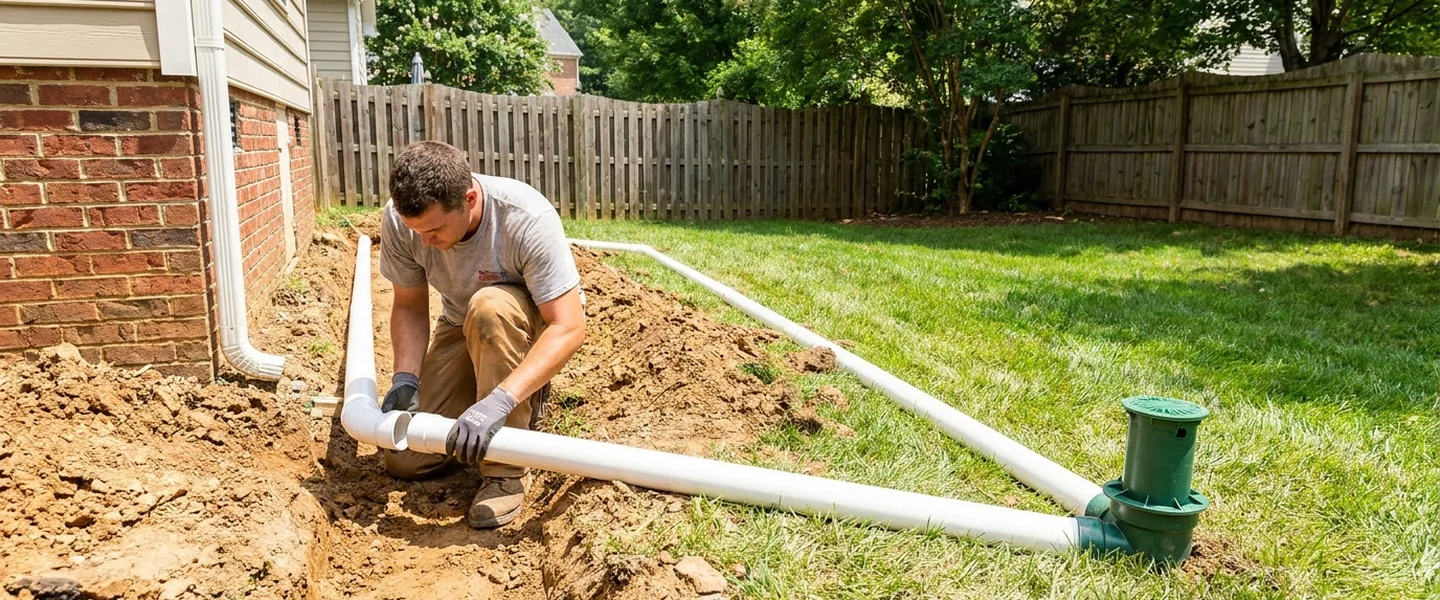
A buried downspout extension is a 4-inch rigid PVC pipe that runs from the bottom of your downspout, underground, to an outlet point 8-12 feet away from the foundation. The outlet is either a pop-up emitter (a small lid that lifts when water flows and lays flat otherwise, for flat yards) or a daylight outlet (an open end at a lower grade point, for sloped yards). The pipe is sloped at 1/4 inch per linear foot consistently away from the home, so water flows by gravity without pooling.
Why the Splash-Block Standard Fails
A splash block deposits roof water onto the ground 2-3 feet from the foundation. During a 4″/hour piedmont thunderstorm, a single downspout can be moving hundreds of gallons of water per hour. That water saturates the soil at the corner of the home, builds up hydrostatic pressure against the foundation wall, and migrates inward through any crack, gap, or porous joint. In the Raleigh metro’s red Piedmont clay (which absorbs water slowly and releases it slowly), this saturation persists for days after a single heavy storm.
What This Causes Over Time
Foundation cracks. Hydrostatic pressure against the foundation wall opens hairline cracks at corners and at the base. These cracks then transmit moisture inward. Over 5-15 years, the crack pattern progresses into structural concerns.
Basement and crawlspace water entry. Saturated soil at the corners of the home produces water entry into basements (where they exist in older Wake Forest homes) and crawlspaces. Once water enters the crawlspace, humidity rises, mold grows on floor joists, and the chain of indoor-air-quality problems begins.
Settling of slabs and walkways. Garage floors, sidewalks, and pavers near the downspout exit settle as the underlying soil is repeatedly saturated and drained. The visible cracks in the garage floor at the corner near the gutter downspout almost always trace to this cause.
Landscaping and mulch erosion. The localized over-saturation washes mulch and topsoil away from the planting beds near the downspout exit. Raleigh-area homeowners spend money refreshing mulch year after year without addressing the underlying cause.
The Buried Extension Fix
A buried PVC extension routes the water 8-12 feet from the foundation before it daylights or pops up. That distance is far enough that the saturation zone doesn’t extend back to the foundation, even on red clay soils. The cracks stop opening, the basement stays dry, the garage floor stops settling, and the mulch stays in place. It’s one of the highest cost-benefit interventions on a Raleigh home.
Pop-Up Emitter vs Daylight Outlet
Pop-up emitter: Used when the yard is mostly flat and there’s no natural low point to drain to. The emitter is a small lid that lifts when water flows from below and lays flat (so you can mow over it) when there’s no flow. Water deposits to a small splash area at the emitter — far enough from the foundation that there’s no saturation issue.
Daylight outlet: Used when the yard has a natural slope to a lower point. The PVC pipe simply ends at that lower point, with a splash-resistant grate at the end. Cheaper than a pop-up emitter and more reliable (nothing to fail mechanically).
The inspection visit determines which configuration is right for your specific yard. Most Raleigh-area lots are flat enough to need pop-up emitters; older lots with more grade variation often work with daylight outlets.
Why We Use Rigid PVC, Not Corrugated
You’ll sometimes see contractors install corrugated black plastic pipe for buried extensions. We don’t, and here’s why: corrugated pipe has internal ribs that catch debris, and the convoluted wall doesn’t survive freeze-thaw cycling well. Within 5-10 years, corrugated pipe clogs internally and starts collapsing. The buried run then has to be excavated and re-installed.
Rigid Schedule 40 PVC has a smooth interior that doesn’t catch debris, has a long lifespan in buried applications (50+ years), and resists the freeze-thaw cycling that the Triangle sees in January and February. The material cost is higher, the install is more careful, but the result lasts the life of the home.
What the Install Involves
The full install for a typical 4-downspout home takes a single day. Trenches are dug 8-12 feet from each downspout, sloped consistently at 1/4 inch per linear foot away from the home. PVC pipe is laid in the trenches with glued joints. The downspout connection at the home gets a cleanout fitting so the run can be snaked clear if a clog develops. The outlet end gets either a pop-up emitter or a daylight outlet. The trenches are backfilled with the original soil, compacted in 6-inch lifts, and the surface is restored with sod or seed.
Sequencing With Other Gutter Work
The buried extensions should be installed at the same time as any gutter or downspout replacement work. Upgrading from 2×3 to 3×4 downspouts during a gutter replacement and then leaving the downspout exits draining to splash blocks is missing half the value of the upgrade. Coordinated install of the gutters, downspouts, and buried extensions produces a complete drainage solution that handles the worst storms without any moisture migration back to the foundation.
What About Connecting to the Storm Sewer?
In some Raleigh-area neighborhoods, the storm sewer is available at the street and can accept residential downspout drainage with a permit. We do not connect to storm sewers without an explicit permit from the local jurisdiction. Most Raleigh-area homes are served by pop-up emitters or daylight outlets to the yard, not storm-sewer connections, and the regulatory and cost overhead of the permit work usually doesn’t justify the storm-sewer connection over a yard outlet.
French Drains vs Buried Extensions
French drains (perforated pipe in a gravel trench) collect groundwater that’s already moving through the soil. They are not the right solution for routing roof water away from the foundation — that’s the job of the solid-wall PVC buried extension. We install both, but they solve different problems: French drains for groundwater control, buried extensions for roof-water routing. Sometimes a home needs both; usually it needs just the buried extensions.
Cost Benefit Over 10 Years
The install cost of buried extensions on a typical 4-downspout home is dramatically less than the cost of a single foundation-crack epoxy injection. Over 10 years, the moisture problems that buried extensions prevent — crack repair, basement water-entry remediation, crawlspace dehumidification, mulch refresh — typically exceed the install cost several times over. The intervention pays for itself the first time the homeowner skips a basement water-entry remediation.
Common Misconceptions About Buried Downspouts
“My yard is fine, I don’t need them.”
The yard may be fine. The slab edge, the foundation, the crawlspace, and the mulch beds at the corner of the home are usually not. The damage happens out of sight at the corners of the home, not in the visible yard.
“It’s only worth it on homes with basements.”
Wrong. Crawlspace homes (which is most of the older Wake Forest housing stock) suffer the same moisture migration from downspout-adjacent saturation. The buried extensions are just as important on crawlspace homes as on basement homes.
“I’ll just extend the downspout above-grade with a flexible black tube.”
The flexible above-grade extensions are a temporary fix. They get kicked, mowed over, run over, and disconnected constantly. Within a season, most of them are no longer functioning. Buried PVC is set-and-forget.
“I can install the buried PVC myself.”
You can. The challenges are slope consistency (1/4 inch per linear foot, no variation), trench depth, and the connection details at the downspout and the outlet. DIY installs often go in too shallow (subject to lawnmower damage), with inconsistent slope (creating water pooling inside the pipe), or without a cleanout fitting (no way to snake a future clog).
Questions to Ask the Contractor
- What pipe material are you using — rigid Schedule 40 PVC or corrugated black plastic?
- What slope are you grading to, and how do you verify it?
- What outlet style — pop-up emitter, daylight outlet, or storm-sewer connection?
- How do you handle the yard restoration after backfill?
- Is there a cleanout fitting at the downspout connection?
- What’s the warranty on the buried run?
Bottom Line
For most Raleigh-area homes, buried PVC downspout extensions are one of the highest cost-benefit interventions on the property — eliminating the foundation moisture, slab settling, and crawlspace humidity issues that the standard splash-block configuration produces over time. Call (919) 739-4341 for a free 20-30 minute inspection that includes a drainage assessment and a written quote on buried extensions.
Service Areas We Cover
We serve Raleigh and the entire Triangle metro. Click your suburb for local details and what we typically find on homes in your zip code:
Free Gutter Inspection in Raleigh
Same-week appointments. No high-pressure sales. Serving Raleigh and surrounding areas including Cary, Apex, Wake Forest, Garner, Holly Springs, Knightdale, Morrisville, Fuquay-Varina.